
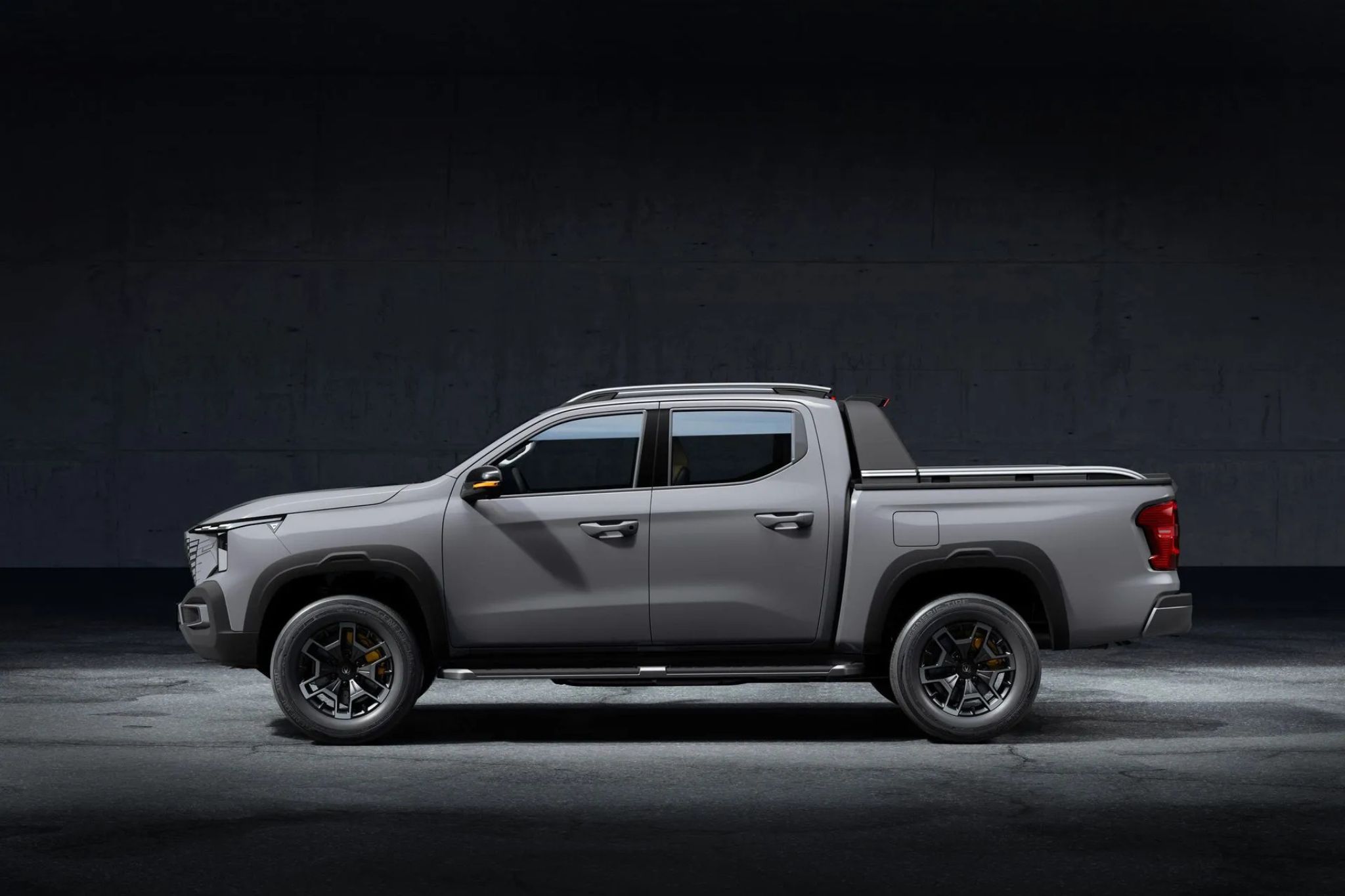
South Africa’s double cab segment is the most competitive it has ever been, and the Changan Hunter is the latest entrant looking to take a bite out of Toyota, Ford and Isuzu’s long-held dominance. If the shape looks familiar, there is a good reason for that, and it is actually one of the Hunter’s strongest selling points.
If you are researching a new bakkie and wondering whether this relatively unknown nameplate deserves a closer look, this guide covers the five things that matter most. By the end you will know:
- Where the Hunter actually comes from (and why that matters)
- The full Changan Hunter diesel specs and drivetrain options
- What kit you get as standard on each trim
- How the warranty and service plan stack up against established rivals
- The honest trade-offs to weigh before it goes any further on your shortlist
Let’s get into it.
The Hunter Is Co-Developed with Groupe PSA (and That Is a Good Thing)
The Changan Hunter is not a clean-sheet Chinese design. It was co-developed with Groupe PSA (now part of Stellantis) and shares its ladder-frame chassis, body structure and core mechanicals with the Peugeot Landtrek. The same platform also underpins the Ram 1200 in Mexico and the Fiat Titano in South America.
That PSA co-development is significant for South African buyers because it means the Hunter’s underpinnings have been engineered, tested and sold across multiple global markets since 2019. The diesel engine, gearbox, chassis geometry and suspension architecture all carry Groupe PSA’s involvement, which brings a level of engineering pedigree that is unusual for a Chinese-branded bakkie at this segment level.
Changan has applied its own exterior design to the front end, its own interior trim finishes and its own branding, but the bones beneath are shared and proven.
Changan Hunter Diesel Specs: What Powers It
The entire diesel Hunter range runs a single 2.0-litre four-cylinder turbodiesel engine producing 110 kW and 350 Nm of torque, with peak torque available between 1,800 and 2,800 rpm. Two drivetrain configurations are available:
- Hunter CS (2WD Manual): Rear-wheel drive with a 6-speed manual gearbox. Claimed fuel consumption of 7.1 L/100 km.
- Hunter CE (4×4 Auto): Selectable four-wheel drive with low-range, a 6-speed automatic gearbox, and a locking rear differential. Claimed fuel consumption of 9.1 L/100 km.
The 80-litre fuel tank gives a theoretical range of around 800 km on the 4×4 auto. In real-world mixed driving, local reviewers have measured around 10.5 L/100 km, which is within the range you would expect from a double cab of this size.
Dimensionally, the Hunter stretches 5,330 mm long with a 3,180 mm wheelbase, placing it in the same territory as the Toyota Hilux and Ford Ranger. Payload is rated at 1,000 kg.
What You Get as Standard on Each Trim
The Hunter follows Changan’s CS and CE trim structure. The entry-level CS (2WD manual) ships with a 10-inch touchscreen with Apple CarPlay and Android Auto, a reverse camera, rear parking sensors, cruise control, 17-inch alloy wheels, fabric upholstery, a 4-speaker audio system, and 6 airbags.
Step up to the CE (4×4 auto) and you add:
- 18-inch alloy wheels
- Imitation leather upholstery
- 6-speaker audio system
- Locking rear differential
- 360-degree panoramic camera
- Lane departure warning
- Hill start and hill descent assist
- Trailer sway control
The Changan Hunter 4×4 review coverage from local press has consistently highlighted the perceived build quality: reviewers took the CE onto rough, rocky terrain and reported no squeaks, rattles or structural complaints, which is a strong early signal for a bakkie at this level.
The Warranty and Service Plan Compared to Rivals
Changan backs the Hunter with a 5-year / 150,000 km factory warranty. The 4×4 CE includes a 5-year / 90,000 km service plan as standard, while the service plan is optional on the 2WD CS.
Here is how that stacks up in the segment:
| Cover | Changan Hunter | Toyota Hilux | Ford Ranger | Isuzu D-Max | GWM P500 |
| Vehicle warranty | 5-year / 150,000 km | 3-year / 100,000 km | 4-year / 120,000 km | 5-year / 120,000 km | 7-year / 200,000 km |
| Service plan | 5-year / 90,000 km (CE) | 6-service / 90,000 km | 4-year / 60,000 km | 5-year / 90,000 km | 7-year / 105,000 km |
The Hunter’s warranty outlasts Toyota and Ford, matches Isuzu on term length and exceeds it on kilometres, but falls short of GWM’s industry-leading 7-year cover. For a brand entering the most scrutinised vehicle segment in South Africa, the warranty is a meaningful trust signal.
The Honest Trade-Offs Worth Knowing
No bakkie is perfect, and the Hunter has a few honest caveats worth factoring in.
Brand track record. Changan is new to the SA bakkie market. Toyota, Ford and Isuzu have decades of local service history, parts availability and resale data behind them. Changan is building its dealer footprint through Jameel Motors (around 25 dealerships nationwide), but long-term parts supply and resale values will take time to establish.
Towing capacity. Changan has not prominently published braked towing figures for the diesel Hunter in South Africa. If towing is a core requirement, this is worth confirming directly with your dealer before going further.
Engine character at highway speeds. Local reviewers have noted that the 2.0-litre turbodiesel runs out of breath at sustained highway speeds, particularly when loaded. It is adequate in the mid-range and around town, but it does not match the refinement of Toyota’s 2.8 GD-6 or Ford’s 2.0 Bi-Turbo at the top end of the rev range.
Changan Hunter vs Hilux. The Hilux remains the benchmark for resale, parts availability and long-term proven reliability. The Hunter’s advantage is its significantly lower entry point with a more complete standard spec sheet and a longer warranty. For buyers who value features and warranty over brand legacy, the Hunter makes a compelling case. For buyers who plan to keep the bakkie for 10+ years or rely on it in remote areas, Toyota’s deeper infrastructure still carries weight.
None of these are deal-breakers, but they are the questions to ask at the dealership before you go further.
Is the Changan Hunter Worth a Closer Look?
If you are researching double cab bakkies in South Africa and value a competitive standard spec, a strong warranty, and PSA-engineered underpinnings at one of the most aggressive entry points in the segment, the Changan Hunter bakkie earns its place on your shortlist. It is not the obvious choice if brand legacy and proven resale value are non-negotiable, but for buyers open to a newer entrant with genuine engineering pedigree behind it, the Hunter is one of the more interesting arrivals in the local bakkie market in recent years.


